How to Draw a Foundation Plan in Autocad Architecture
This command allows yous to find areas indicating an internal point between objects or by selecting closed contours, this control shows the surface area obtained or otherwise sets it in a selected text.
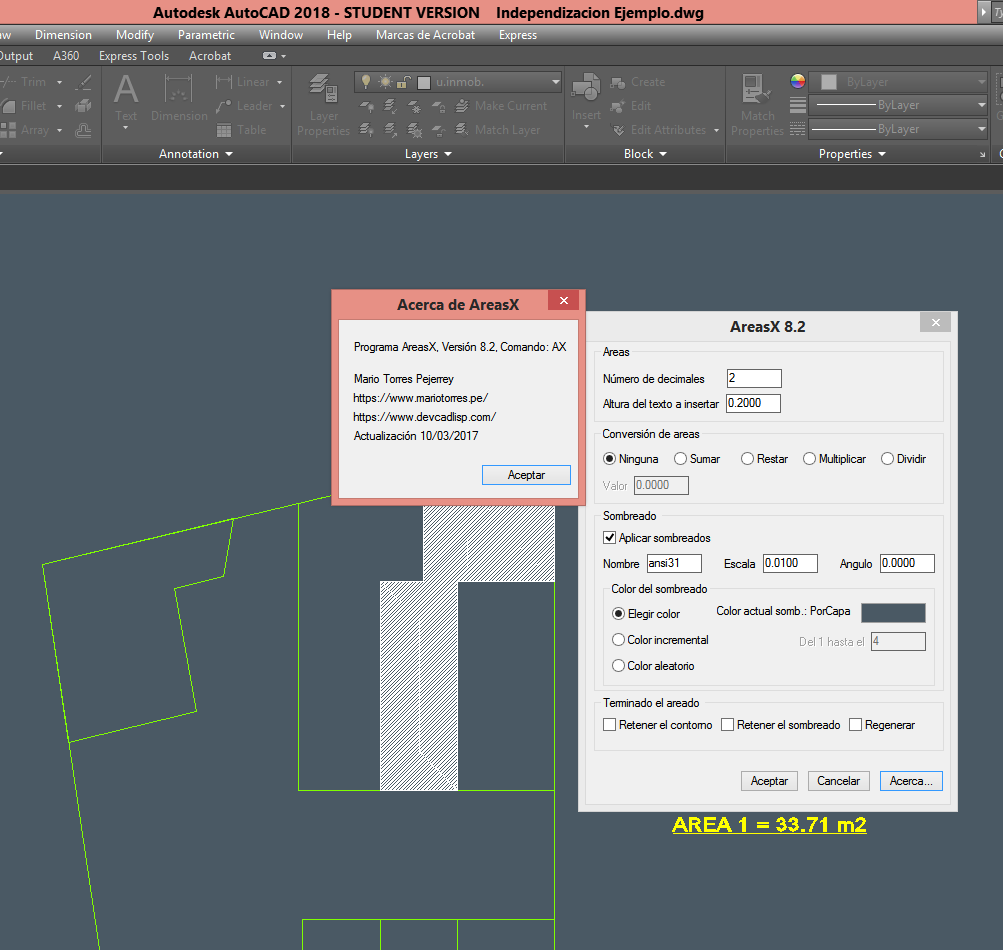
The Ax command has the following options:
Initial requests:
Specify an internal point of the area or [Select object / Options] :
Hither you must indicate the internal points from which the area will be obtained, the other options are described below:
Select object: Instead of specifying internal points to detect airs, you can select closed polygons to notice your area.
Options: This option loads the Command Options dialog box, the dialog box is as follows:
Each option is described below:
Number of decimals: The number of decimal places the area volition have (2 past default).
Tiptop of text to insert: If yous decide to insert a text with the area obtained, here is set the summit that will accept said text.
Conversions of areas: This option allows you to perform operations with the values of the areas plant, each area is added, subtracted, multiplied or divided by a cistron that must exist specified in the lower part of this option.
The command shows if the conversion is active and which of the operations is carried out and with what value the conversion will be carried out.
This option allows you to customize the areas when the drawing is in different scales or in other drawing units.
Apply shading: This option allows each indicated surface area to be shaded to have a better view of the area that is existence found, thus allowing to verify if it is correct (Enabled by default).
Proper noun of the shading: Hither you lot must bespeak the name of the shading to be applied in the indicated areas (Solid default).
(Shading) Scale: Here the scale factor of the shading is indicated, this gene is variable according to the type of shading selected.
Colour (shading): The color that the shading will have applied in the indicated areas.
Finishing the shading: The options below utilise in one case the command application is terminated.
Hold contours: If enabled the generated contours are not deleted.
Hold shading: If enabled the generated shadings are non deleted.
Terminal Requests:
Specify an internal point of the expanse or [Select object / Insert surface area text / Options] :
Insert text area: This pick allows you to insert a text with the obtained area instead of selecting one to replace it. The text with the area constitute has the default prefix: " Area =", this prefix can be modified in the program code.
Modify text: This selection is activated when the Enter key is pressed or the right mouse push button is pressed, which will request a text to be selected, for example if there is a text with the following content: "Ac=0.00m2" and through the command an area of 3.25 has been establish, then the control volition replace the text, updating it to "Ac=iii.25m2". Every bit yous can run into, AX replaces only the numeric values of the text to be replaced, so you lot tin have area texts with different prefixes, for example: "AR=0.00m2", "AM=0.00m2", "Cutting expanse =0.00m2", "My area=0.00m2", etc.
Valid and invalid outlines:
Valid outline
To utilize this routine you must do the post-obit:
- Load the lisp file in AutoCAD.
- Enter the proper noun of the control: AX
- Indicate an internal signal in the area you lot want to find (y'all have to make certain that the area to exist found must be completely closed, otherwise the command will brandish an error bulletin).
- Indicate internal points as many times every bit you need, the command volition rage, accumulating (summing) all the airs found.
- Press Enter or correct-click to stop the command and gear up the area in an existing text.
You lot can become the routine here!
This modest routine performs the same as the previous 1, the departure is that the name of the layer is not entered here to select the objects, but an entity is selected from which yous want to obtain the name of the layer.
As in the previous routine, the choice of entities is not made visible, but it exists equally a gear up of selected entities, so the selection mode must exist indicated "Previous" to select the objects.

To use this routine yous must do the following:
- Load the lisp file in AutoCAD.
- Enter the name of the command: ssl
- Select the object you want to get the layer name to select the other entities
- Make effective the choice of entities past means of the predictive mode
You tin go the routine here!
Using this routine you lot tin delete the objects that are in the inner or outer area of a selected polyline, if the option is indicated, the objects that are intersected by the polyline will be cut past the side indicated.
When it comes to removing objects outside the polyline, special care should be taken as This command deletes all objects exterior the polyline.

The polyline to select Must exist a closed polyline, otherwise the routine joins the final point of the segment with the commencement, Closing thus by means of an imaginary line the polyline and eliminating everything that is inside or outside that line.
The selection cut equally it is logical, only works with objects that tin be cut manually, As for example, lines, circles, arcs, etc, blocks and other compound objects practice not fit within these objects that can exist cut out.
With the lisp a sample file is fastened Then that the respective tests are done before using the command in terminal files.
To use the routine y'all must practise the following:
- Load the lisp file in AutoCAD.
- Enter the name of the command: PolErase
- Select polyline Which will serve as an border to circumscribe the objects to eliminate.
- Choose one delete objects option, you tin choose the choice: Window (it only deletes objects that are totally outside or inside that window), Capture (Removes objects that are even intersected by the border of the polyline), delete and crop (As the name implies, it will erase objects that are within or outside the polyline and trim objects that intersect the edge.
- Indicates a point on which side (internal / external) volition erase or trim objects.
You can get the routine here!
Information technology is a lisp routine that allows you to select all entities that are in the indicated layer, does not distinguish color or other belongings that may have the entity.
This routine is not instance sensitive at the time of inbound the name of the layer, then you tin can enter in whatsoever way, just that it is well written.
To utilize this routine y'all must do the following:
- Load the lisp file in AutoCAD.
- Enter the proper noun of the control: sca
- Enter the layer name of the objects yous want to select
- Outcome the selection of entities by means of the way Previuos
Yous tin can get the routine here!
It is a routine made with the autolisp programming linguistic communication, it allows us to copy the content of a selected text, and prepare that value in a 2d text to be selected.
To use this routine, you must do the following:
- Load the lisp file in AutoCAD, using the comado Appload Or but past copying the file and pasting it into AutoCAD.
- Enter the name of the command: RT
- Select the text, from which you want to get the value.
- Select the text, which you desire to replace with the previously obtained value.
As y'all tin see, the routine is simple, only information technology is very helpful when it comes to text editing.
It should be noted that the linguistic communication used in this routine is clearly AutoLisp, in a new entry we volition publish the same command just written in VisualLisp, in which nosotros will observe that the size of the structure is further reduced.
You tin can get the routine hither!
This lisp routine allows you to change the number of decimals of the selected texts without losing the original number of decimals, with that you can brandish a number for example with two decimals, but internally information technology volition have a new holding with its originally defined value.
This new property tin can only be accessed by this command, since it is not listed past the Properties dialog box.

The lisp allows y'all to change the number of decimals or obtain the original number of a text formatted before with this routine, So yous know how many decimals you lot had originally If you desire to reset the original values.
It is noteworthy that these original values remain Fifty-fifty though the file or AutoCAD has been closed, so you accept the security that the original data of Your values will always exist there, even in spite of restoring the original values to the texts.
This new command could exist compared to the action of To change Excel decimals, Simply the only observation is that this property is internal and as we said earlier The Properties window is non fix to brandish extended engagement entities.
Particular consideration must exist given to The selected texts are numerical texts, that is, they simply contain numbers, since otherwise their value volition be converted to "0.00".
To use the routine you lot must practice the following:
- Load the lisp file in AutoCAD.
- Enter the name of the command: AREDE
- Choose one of the options you want to perform
- Select the (numeric) texts in which you want to perform the operation
Yous can get the routine here!
Routine adult with AutoLisp that allows united states to align several texts based on the first ane selected.

The program allows you to align the texts vertically (columns) or horizontally (rows), for this you only have to select the first, which volition serve every bit a basis for aligning the other texts.
It should exist noted that the point taken equally the basis for aligning the texts is the insertion point, if all the texts have the "Left" justification as the insertion point, all of them will be aligned with respect to this point and it will be a uniform alignment. If the texts accept different justification, they volition all exist aligned with respect to their insertion point, which volition cause the alignment of the texts to exist inconsistent.
To use this routine y'all must do the following:
- Load the lisp file in AutoCAD.
- Enter the proper name of the command: lit
- Select the base text from which the alignment axis will exist obtained
- Select the texts to align
- Washed, the texts were aligned based on the first selected
You tin can become the routine here!
Source: https://www.twingeo.com/44-routines-lisp/
0 Response to "How to Draw a Foundation Plan in Autocad Architecture"
Post a Comment